TL;DR
- The gap Sonar’s 2026 survey found 42% of committed code is AI-generated or AI-assisted. 96% of developers don’t fully trust it, yet only 48% always verify it before committing.
- Why it’s harder to review AI-written code arrives without an author’s reasoning, and 38% of developers say reviewing it takes more effort than reviewing a colleague’s code.
- The volume problem Developers expect AI’s share of committed code to reach 65% by 2027, so review becomes the constraint unless capacity grows with it.
- What works Automated checks on every commit, an AI first pass on each pull request, and human approval, with senior engineers reviewing high-risk changes.
- Where to start Write the review standard down, pick the riskiest changes, assign owners, and automate every check a machine can run.
Where trust and checking diverge
Developers report that 42% of the code they commit is now AI-generated or AI-assisted. Fewer than half say they always check it before committing. Those figures come from Sonar's 2026 State of Code Developer Survey of more than 1,100 developers, which also found that developers expect AI's share of committed code to reach 65% by 2027.
The disconnect is in the trust numbers. 96% of developers said they do not fully trust that AI-generated code is functionally correct, yet only 48% said they always verify it before committing. Sonar calls this the verification gap.
One caveat: the figures are self-reported, in a survey run by a vendor of code verification tools. They show what developers say about their own habits, not measured commit data. Read cautiously, the pattern holds: AI-written code is arriving faster than teams are checking it.
Why reviewing AI-written code is harder
Reviewing AI-written code takes more care than reviewing a colleague's pull request, because nobody on the team reasoned through the logic. When a teammate writes a change, the reviewer can ask what they were thinking, and the author carries context about the system. Code generated from a prompt arrives without that reasoning, so the reviewer has to work out what it does, whether it fits the architecture, and what it assumes.
Volume adds pressure. If AI's share of committed code climbs toward the 65% developers expect by 2027, the number of changes that need a careful look climbs with it. Unless review capacity grows at the same pace, review becomes the constraint.
Sonar calls the result a verification bottleneck: the slow part of building software shifts from writing code to validating it. In the survey, 38% of developers said reviewing AI-generated code takes more effort than reviewing code written by their colleagues.
What a review standard needs
A review standard answers six questions in writing, so every engineer applies the same rules to AI-written code.
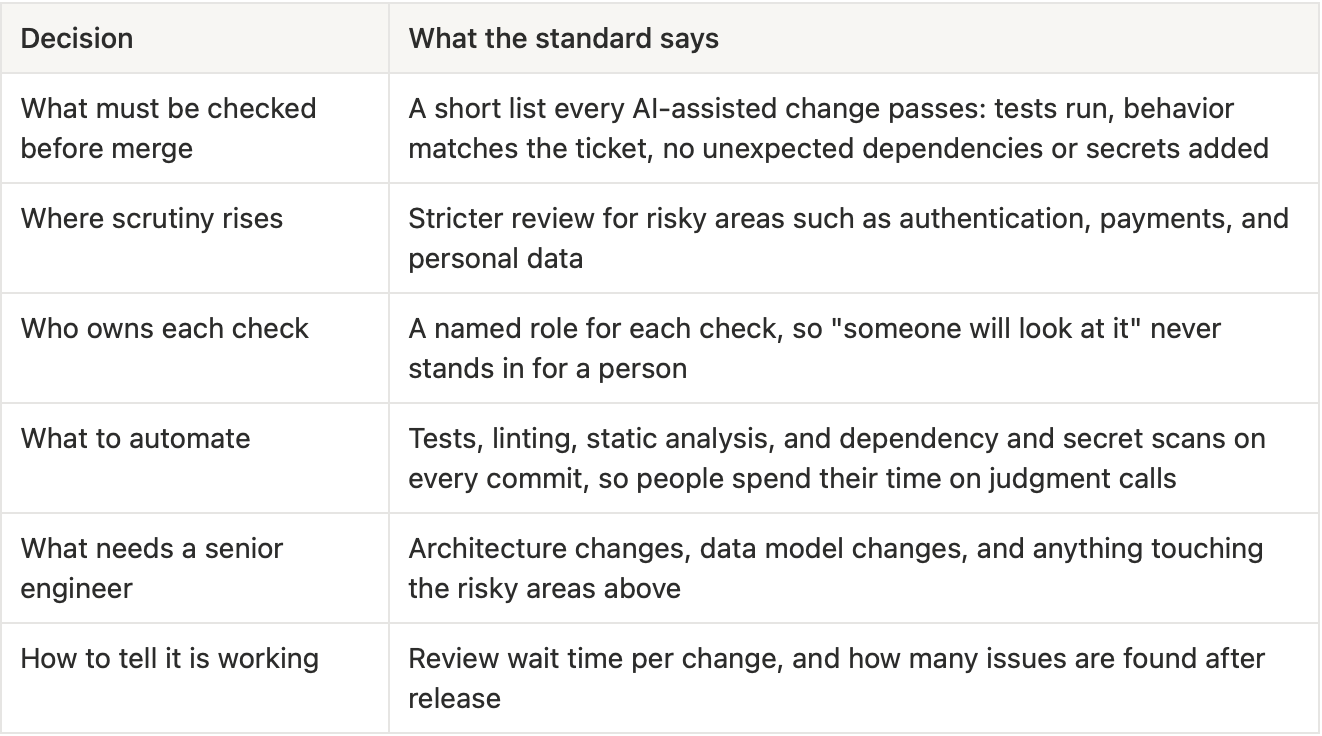
This is practical guidance, not survey data, and the right thresholds depend on how risky the product is.
What an AI-assisted review workflow looks like
An AI-assisted review workflow puts automated checks and an AI first pass underneath human approval, so people spend their attention on the changes that need judgment.
- Automated checks run on every commit: tests, linting, static analysis, and dependency and secret scans. A change that fails never reaches a reviewer.
- An AI reviewer does a first pass on the pull request. It summarises what changed and flags likely bugs, missing tests, and risky patterns.
- A person reviews the change. Low-risk changes need one approver, and changes in high-risk areas need a senior engineer.
- The pull request records where AI was used, so reviewers know which changes deserve a closer read.
- After release, the team tracks issues found after merge and feeds the patterns back into the review standard.
The AI first pass narrows what the reviewer has to read. The approval stays with a person who owns the outcome.
Our take
AI's speed only pays off when the code that ships has been verified, so we treat review as part of the build rather than a step after it. Three ideas guide how we think about it:
- Write the standard down. Unwritten rules leave each reviewer guessing, and Sonar's survey found junior developers are more likely than their senior colleagues to say reviewing AI code takes more effort.
- Automate every check a machine can run. Human attention then goes to design, risk, and intent.
- Keep a person accountable for each approval. A tool can flag a problem, but someone has to own the outcome.
Done well, this lets a team keep AI's speed without letting unchecked code pile up.
Where to start
Start by writing the review standard down while AI's share of your code is still manageable. Pick the changes that carry the most risk, decide who owns their review, and automate every check a machine can run. Then add an AI first pass underneath human approval.
Which part of your review process would struggle first if AI wrote twice as much of your code?
Want an AI review workflow set up for your team? Let's talk.