Wearables: From Dashboards to Decision-Makers
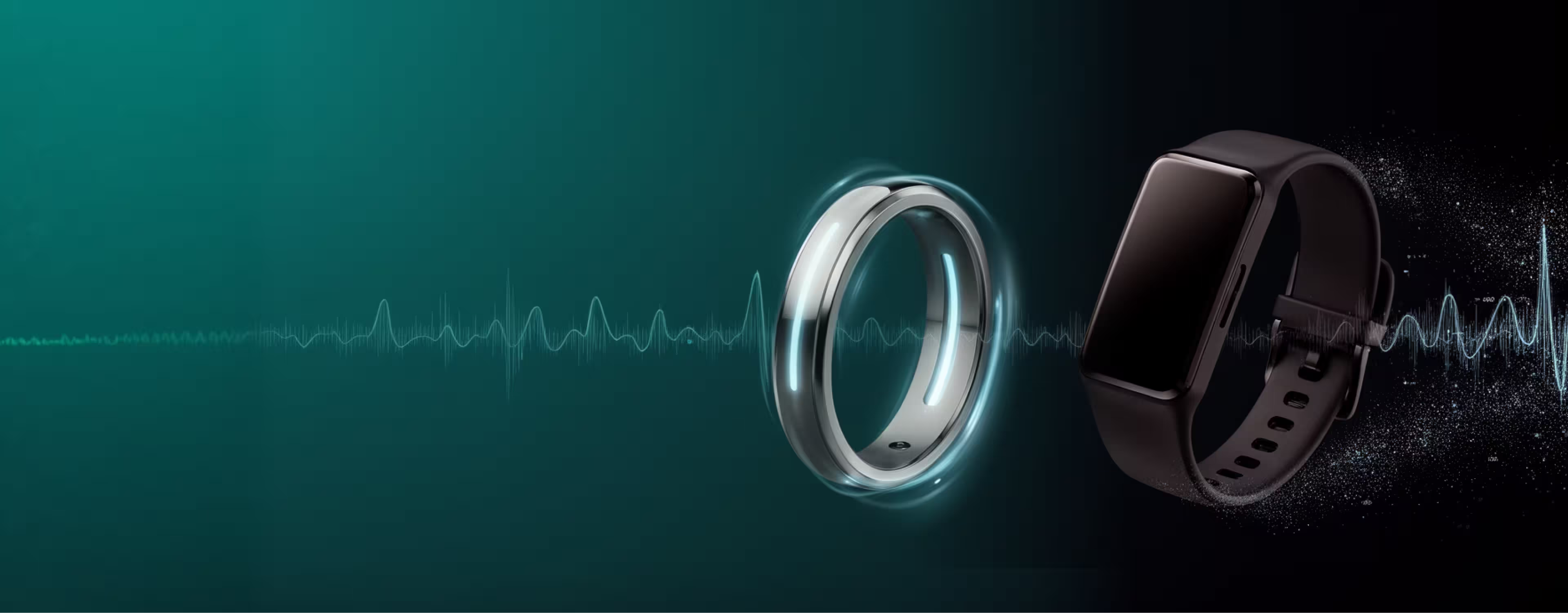

Wearables used to just collect data. Steps, heart rate, sleep hours, numbers on a screen that you had to interpret yourself. That's no longer the bar.
Look at where the category is heading in 2026. ŌURA Ring is now syncing with your biological clock to flag when cortisol is too high for a late workout. Brands like OURA, WHOOP, Apple and Garmin spent the last year turning sensors into full systems built around stress, sleep, biomarkers and AI guidance, not just raw metrics. A company called Linc is even pairing with Whoop, Oura and Apple Watch to mix personalized supplement drinks based on someone's recovery and biometric data. The device doesn't just tell you what happened anymore. It tells you what to do next, and increasingly, it just does it for you.
Less of a dashboard, more a decision-maker.
And the market is responding to it. The wearables market is on track to grow from around $71 billion today to nearly $293 billion by 2032, and a big part of that growth is people wanting insights that feel personal instead of generic. Once users experience a device that adapts to them specifically, a flat dashboard of numbers starts to feel outdated.
For founders and product teams building in this space, that raises the bar fast.
A few things we're seeing matter most: Data alone isn't a feature anymore, anyone can show a heart rate graph. The value is in turning that data into a recommendation someone can act on in the moment, like Oura suggesting you skip the workout instead of just showing you a stress score and leaving you to figure it out.
Multi-device data is becoming the norm, not the exception. People wear an Oura ring for sleep and a Garmin for runs, or stack an Apple Watch with a Whoop. Pulling those streams together into one coherent picture is where a lot of the value gets created, but it also means your product has to handle several inconsistent data formats and sync methods at once.
Personalization has to earn trust, not just look smart. The more a device starts making calls on someone's health or routine, the more users care about where that recommendation came from and what's happening with their data behind it.
This is also where a lot of the engineering difficulty hides. Integrating each wearable API separately can take four to eight weeks of developer time per device, and every wearable speaks its own language with different authentication methods and data formats. Add in HIPAA-level data handling once health data is involved, and the "simple personalization feature" a founder pitched in a deck turns into a real infrastructure problem.
We've worked through exactly this kind of build, plugging multiple data sources into one model, designing for trust, keeping the architecture ready to scale as more devices and signals get added.
Building something in this space and not sure how to structure the software layer? Let's talk 🔗 https://lnkd.in/gUcz2bfY